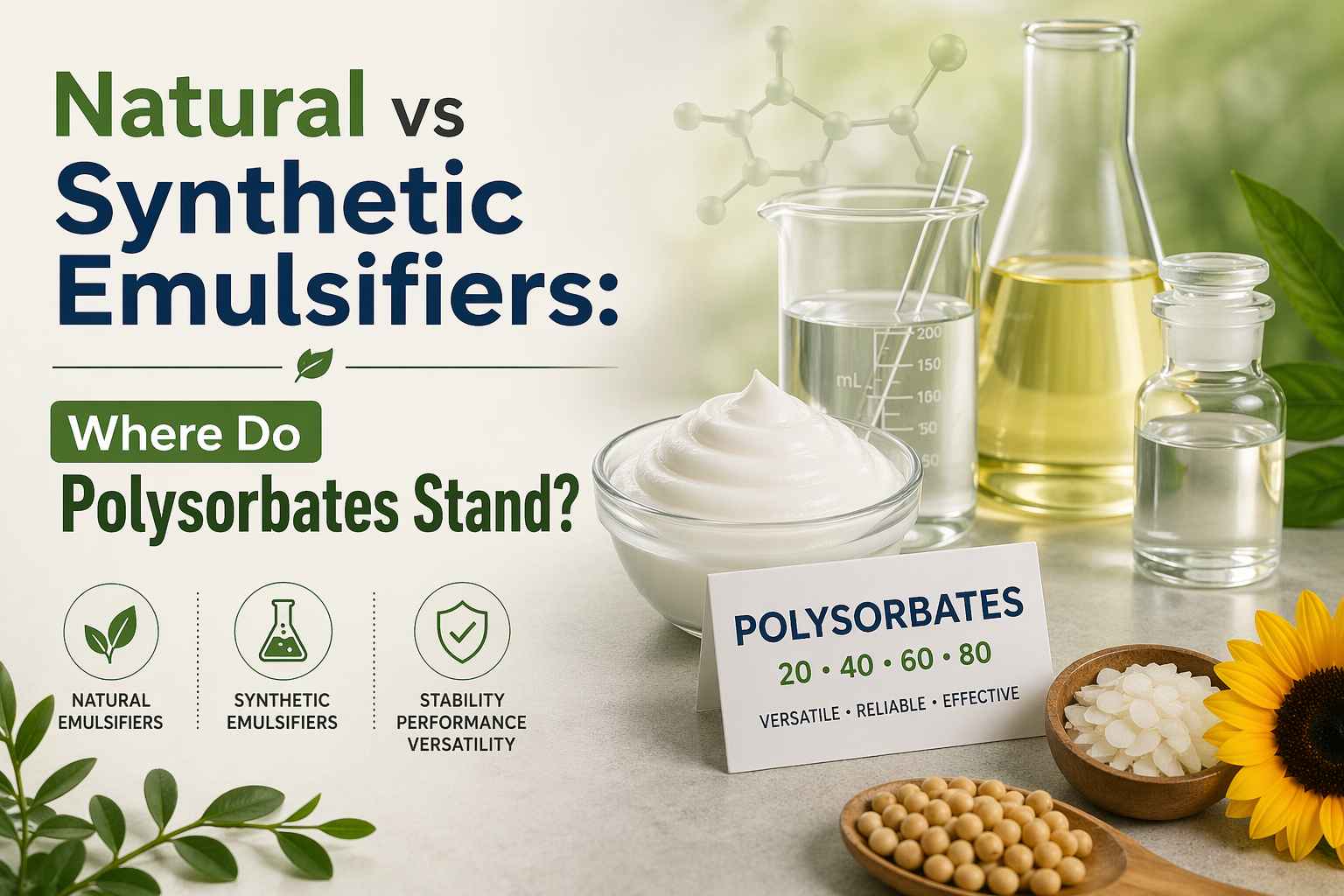
Walk into any formulation lab today and you’ll hear the same conversation playing out on repeat. Should we go natural? Stick with synthetics? Blend both? The emulsifier debate has quietly become one of the biggest decisions manufacturers face, and it’s shaping everything from personal care launches to food innovation pipelines.
Somewhere in the middle of this tug-of-war sits a category that refuses to be ignored: polysorbates. They’ve been around for decades, they’re trusted by formulators across continents, and they keep showing up in new product development briefs. So where exactly do they stand in the natural-versus-synthetic conversation? Let’s break it down.
What Are Polysorbates, Really?
Polysorbates are non-ionic surfactants derived from sorbitol and fatty acids. In simple terms, they’re the bridge that helps oil and water play nicely together. You’ll usually see them labeled as Polysorbate 20, 60, or 80, with the number referring to the type of fatty acid attached.
What makes them interesting is their versatility. They emulsify, solubilize, stabilize, and disperse, all in a single ingredient. That’s why formulators across industries keep reaching for them when other options fall short.
Natural vs Synthetic Emulsifiers: The Real Difference
Natural emulsifiers, like lecithin, xanthan gum, or beeswax, come straight from plant or animal sources. They appeal to clean-label trends and resonate with consumers chasing transparency.
Synthetic emulsifiers, on the other hand, are engineered for precision. They deliver consistent viscosity, predictable HLB values, and reliable shelf life. When scale and performance matter, synthetics typically win on technical grounds.
Polysorbates sit in an interesting spot. They’re synthesized, yes, but they’re built on sorbitol and fatty acids, both of which trace back to natural origins. That hybrid character is part of why they’ve stayed relevant through every shift in formulation philosophy.
Where Do Polysorbates Get Used?
The application list is genuinely impressive. A few industries where polysorbates pull serious weight:
- Personal care and cosmetics: Shampoos, lotions, micellar waters, fragrance solubilizers, and serums rely on them for clarity and stability.
- Food and beverage: Ice cream, whipped toppings, salad dressings, and baked goods use polysorbates to control texture and extend freshness.
- Agrochemicals: Herbicide and pesticide formulations use them as wetting agents and dispersants to improve spray coverage.
- Industrial cleaning: Surface cleaners and degreasers benefit from their solubilizing power.
- Oil and gas: Certain drilling fluids and specialty chemical blends use polysorbates for emulsion control.
One ingredient, dozens of end uses. That’s not common, and it’s a big reason procurement teams keep them on the shortlist.
Why Is Demand for Polysorbates Growing Globally?
A few trends are pushing the numbers up. Clean beauty hasn’t killed synthetic emulsifiers, it’s just made formulators pickier about which ones they use. Polysorbates, thanks to their sorbitol-based backbone, often pass that filter.
Food manufacturers in North America and Europe are scaling production of ready-to-eat and frozen categories, both of which lean heavily on emulsifier performance. In Asia, growth in personal care manufacturing, particularly in India, South Korea, and Southeast Asia, is driving fresh demand for industrial-grade polysorbates in bulk volumes.
There’s also the cost factor. Natural emulsifiers can be unpredictable in price and availability. Polysorbates offer something natural alternatives often can’t: reliable, scalable, cost-efficient supply.
Key Benefits for Manufacturers and Bulk Buyers
Here’s what actually matters when you’re placing a purchase order:
- Consistency across batches: Synthetic production means tight specifications every time.
- Scalability: Whether you need 500 kg or 50 tonnes, industrial-grade polysorbate manufacturers can support commercial volumes.
- Compatibility: They play well with a wide range of actives, oils, and aqueous systems.
- Regulatory acceptance: Approved across major global markets including the US, EU, and most Asian economies.
- Customization: Grades can be selected based on HLB requirements, end-use application, and purity level.
For formulators, that translates into fewer surprises. For procurement, it means easier planning.
How Do You Choose the Right Polysorbate Supplier?
This is where a lot of buyers get stuck. Not every supplier operates at the same level, and the difference shows up in your final product. A practical checklist:
- Grade specifications: Does the supplier offer food, cosmetic, and industrial grades separately?
- Documentation: COA, MSDS, kosher, halal, and other certifications should be standard, not a favor.
- Manufacturing capacity: Can they actually deliver the volumes you need without delays?
- Export experience: Global shipments require customs know-how, stable packaging, and clean logistics.
- Technical support: A good supplier helps you troubleshoot, not just ship drums.
Buyers sourcing from India have a particular advantage here. Indian manufacturers of polysorbate 20 and polysorbate 80 have built strong reputations for competitive pricing paired with export-grade quality, serving markets across the US, Europe, Middle East, and Africa.
The Global Supply Picture
Demand is distributed, but supply is concentrated. India, China, and select European producers handle the bulk of global output. India, in particular, has carved out a reliable position as a source for bulk polysorbate exports thanks to cost competitiveness and improving infrastructure. Buyers in regulated markets often prefer Indian suppliers who meet international compliance standards while offering flexibility on volume.
Final Thoughts
The natural-versus-synthetic debate isn’t going away, but it’s also not as black-and-white as it once seemed. Polysorbates occupy a thoughtful middle ground, synthesized for performance, rooted in natural chemistry, and trusted across industries that can’t afford to compromise on either.
For manufacturers, formulators, and bulk buyers planning their next procurement cycle, the question isn’t really whether polysorbates belong in the mix. It’s finding the right supply partner who can deliver the grade, volume, and consistency your formulations demand, batch after batch.